
Blog
Grief, Love and the Strength That Never Leaves

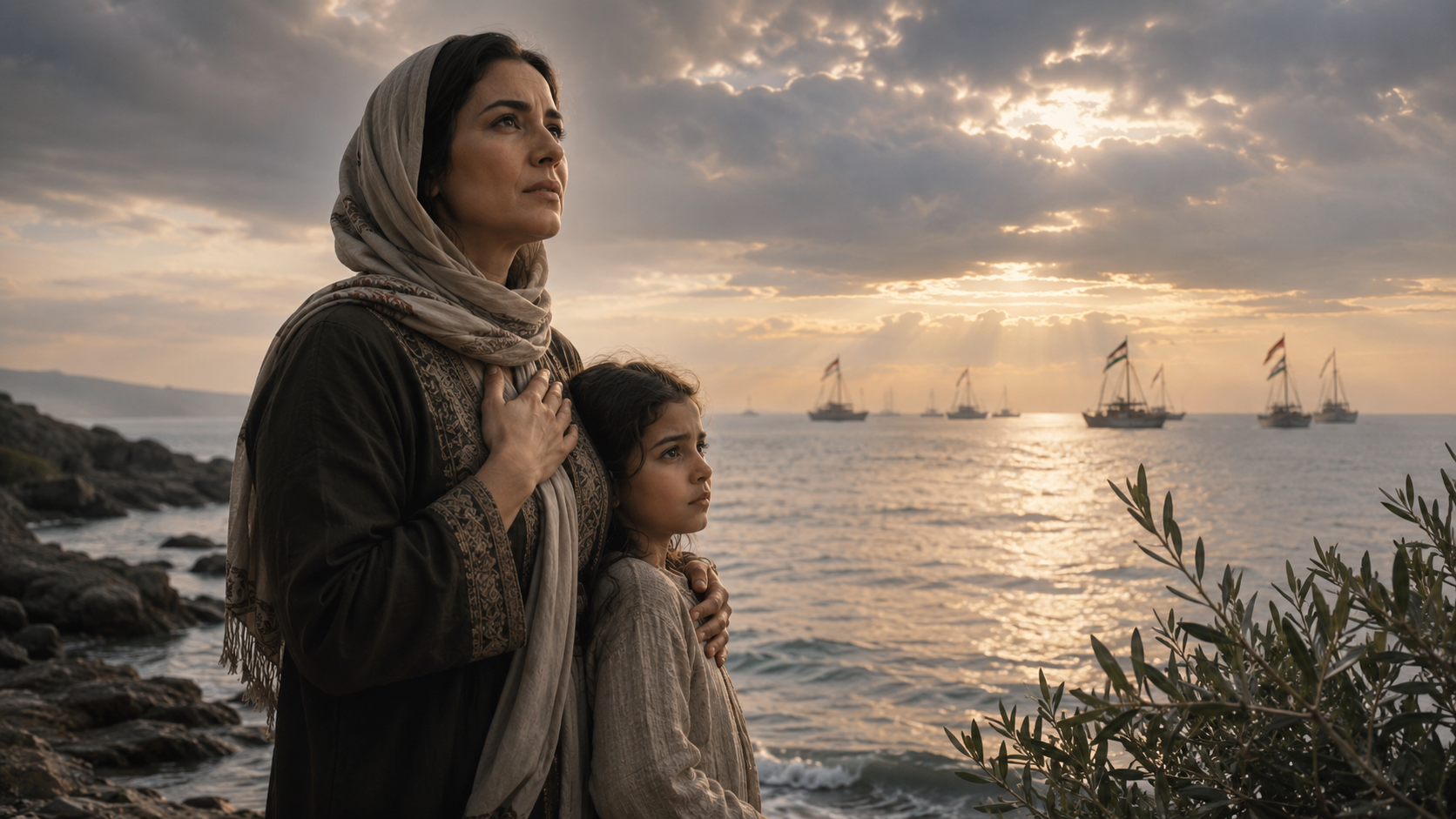
Unbroken Spirit
It has been four years this month since my beloved father passed away.
Four years since grief entered my life so violently that it felt as though my skin had been torn away and my soul left exposed. My heart overflowed. My eyes carried more tears than I thought a person could hold, and I could not imagine ever experiencing that depth of love, connection and loss again.
The love between a parent and child is sacred. It is not held only in photographs, memories or familiar places. It travels through the bloodstream. It lives in our mannerisms, our values, our prayers and the way we love others.
Death may remove a person from our sight, but it cannot remove the love they planted within us.
That love remains.
And sometimes, years later, something happens in the world that touches that same place of grief.
When Another Person’s Pain Feels Like Our Own
Recently, that deep ache returned as I followed the interception of the Sumud Flotilla.
For me, the flotilla was never simply about reaching a geographical destination. It represented something far greater. It was a living reminder that food, water, freedom, safety and dignity are not rewards to be granted by those in power.
They are fundamental human rights.
They belong to every mother trying to feed her child.
Every father trying to protect his family.
Every elderly person longing to remain in the home that carries their memories.
Every child who should be free to learn, laugh, sleep and dream without fear.
Human rights are not privileges reserved for certain nations, races, religions or communities. They are God-given rights, as essential as the air entering our lungs and the hearts beating inside our chests.
The Power of a Mother
There is a particular power within a mother.
It is the power to nurture life, but also the power to defend it.
A mother understands that a child does not need to belong to her biologically for that child’s suffering to touch her heart. She recognises hunger in another mother’s child. She understands the terror of being unable to protect the little body that once rested beneath her heart.
The power of a mother is not weakness, sentimentality or passive tenderness.
It is fierce love.
It is the courage to speak when silence would be easier.
It is the refusal to accept that some children deserve safety while others must negotiate for survival.
Motherhood teaches us that love is not merely something we feel. Love is something we protect.
The Power of a Woman
The power of a woman is often misunderstood because it does not always announce itself loudly.
Sometimes it looks like a woman rebuilding her life after loss.
Sometimes it looks like caring for others while carrying wounds no one can see.
Sometimes it is found in the woman who refuses to surrender her dignity, even when others attempt to humiliate her.
Women have always carried communities through grief, displacement, illness, poverty, war and uncertainty. We have cooked when our own hearts were broken. We have comforted children while swallowing our own fear. We have preserved stories, protected traditions and held families together when the world around us was falling apart.
Yet a woman’s strength should never be used as an excuse to keep placing unbearable burdens upon her.
Her strength must be honoured. Her voice must be heard. Her humanity must be protected.
The Power of Being Human
Before we are divided by nationality, religion, race, language or politics, we are human.
To be human is to recognise ourselves in one another.
It is to understand that another person’s suffering does not become less important because it is happening far away. A child’s hunger is still hunger. A mother’s grief is still grief. A family’s fear is still fear.
Our shared humanity places a responsibility upon us.
We each carry a sacred duty to protect, honour and celebrate life — not selectively, but universally.
We are called to become the strength of the oppressed and the conscience of the oppressor. We are called to remind those who misuse power that dignity cannot be permanently imprisoned, truth cannot be erased, and humanity cannot flourish where cruelty is normalised.
The spirit of sumud — steadfastness — calls us back to our divine default settings:
Compassion. Justice. Mercy. Courage. Humanity.
When Peace Feels Hollow
When news of a ceasefire arrived, I did not immediately feel joy. Instead, I felt disillusionment.
How has humanity reached a place where the basic rights of innocent people must be negotiated?
How can a child’s access to food, water, medicine and safety become the subject of political bargaining?
How can freedom be rationed?
How can breathing, living and dreaming require permission?
A pause in suffering is important. Every life spared matters. Every family reunited matters. Every child able to sleep through the night matters.
However, true peace cannot simply mean the temporary absence of visible violence.
Peace must include justice.
It must include freedom, dignity, accountability and the right of ordinary people to live without fear.
Without justice, peace becomes fragile — a silence beneath which pain continues to grow.
A Sliver of Light Within the Darkness
And yet, even in the darkest moments, the human spirit searches for light.
I felt a small sliver of happiness when I saw Palestinians casting their nets into the sea, reclaiming, even briefly, an ordinary moment of life.
There was something deeply moving in that image.
The sea was still there.
The hands still remembered how to work.
Hope had not completely disappeared.
Sometimes resistance is not loud. Sometimes it is found in the simple act of continuing to live.
Another wave of emotion came with the memory of journalist Saleh Al-Ja‘farawi, whose work and death touched people far beyond those who knew him personally.
I had never met him, yet the grief felt strangely familiar — almost like losing a member of my own family.
Perhaps this is what love and humanity do. They dissolve the boundaries between “my people” and “your people.” They remind us that grief does not require an introduction before entering the heart.
Strength Recognises Strength
Then, through what felt like divine design, I met Dr Fatima Hendricks — a survivor, healer and activist.
Listening to her experience aboard the Sumud Flotilla awakened something within me.
She spoke of being intercepted in international waters and of the humiliation and mistreatment she endured. As a cancer survivor who had undergone a mastectomy, even the most personal evidence of her survival was reportedly used in an attempt to degrade her.
Yet her spirit remained unbroken.
There is extraordinary power in meeting a woman who has walked through illness, fear and humiliation, yet still chooses purpose over bitterness and courage over silence.
Her story reminded me that resilience does not mean we are untouched by pain.
Resilience means pain does not receive the final word.
It reminded me of the strength of women.
The strength of mothers.
The strength of survivors.
The strength of human beings who refuse to surrender their conscience.
Love Must Become Justice
Love is often spoken about as though it is soft, private and comfortable.
But real love is demanding.
Love asks us to care beyond convenience.
Love asks us to tell the truth.
Love asks us to stand beside those whose voices are being ignored.
Love without justice can become little more than sentiment. Justice without love can lose its humanity.
We need both.
Love gives justice a heart.
Justice gives love a backbone.
Together, they call us to resist oppression without losing our compassion, to pursue truth without abandoning mercy, and to protect life without deciding whose life matters more.
Today, I Feel Hopeful
Today, I feel hopeful.
Not because the suffering has ended.
Not because every wrong has been corrected.
Not because grief has disappeared.
I feel hopeful because grief may linger, but so does love.
The love I carry for my father did not end with his death. It became part of my purpose, my compassion and the way I now understand the pain of others.
Love has the power to move through grief and become service.
It can become courage.
It can become resistance.
It can become the decision to stand for truth, defend human dignity and keep faith in our shared humanity.
Today, my strength is renewed.
I remember that I am a daughter shaped by love.
A mother called to protect life.
A woman who carries resilience within her.
And a human being with a responsibility to care.
This is our power.
Not the power to dominate, silence or destroy.
The power to love so deeply that we refuse to look away.
The power to remain human in a world that repeatedly tries to make suffering feel normal.
The power to choose justice, even when justice is inconvenient.
The power to carry grief without allowing it to extinguish hope.
And the power to rise — again and again — with our hearts still open.
“The greatest expression of love is not only how tenderly we hold those closest to us, but how courageously we defend the dignity of people we may never meet.”
A Gentle Reminder to Care for the One Who Cares
Women who carry the pain of families, communities and the wider world also need moments of rest. Self-care does not mean turning away from injustice. It means tending to your emotional and physical wellbeing so that you can continue to live, love and serve with purpose.
Create a quiet ritual with the Aphrodite’s Garden Relax Oil or Aromatherapy Rollers — breathe slowly, soften your shoulders and remind yourself that caring for your own nervous system is also part of responsible, sustainable activism.
Self-care is not an escape from purpose. It is how we protect the strength required to live it.
https://www.aphroditesgarden.co.za/product/relax-aromatherapy-massage-oil/