
Blog
Is Midlife a Season of Truth?

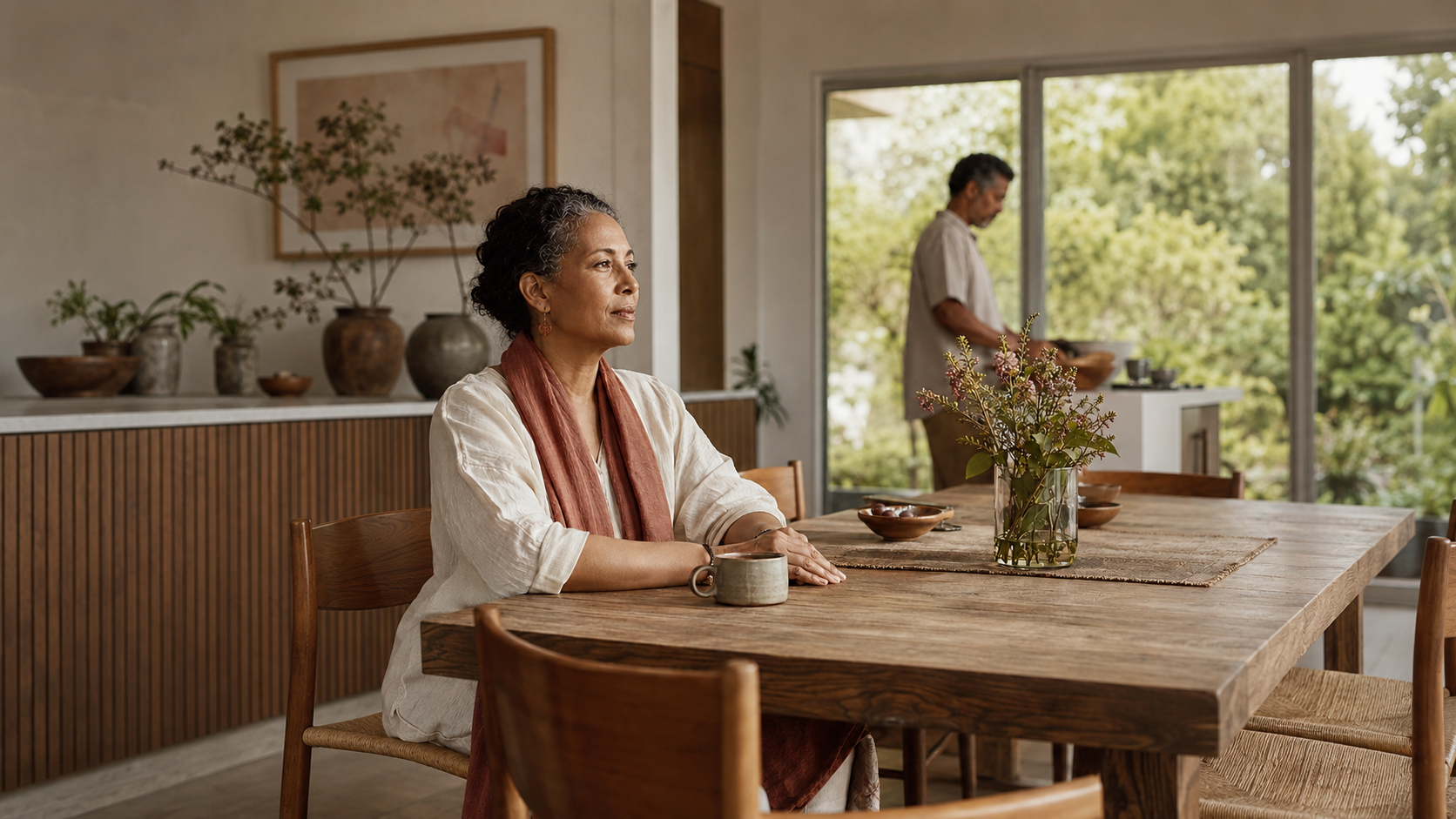
Part two of the three-part series: Benevolent Distance — Love, Midlife and Active Healing
There is a popular story circulating about midlife women: one day her hormones change, her patience disappears and she suddenly wants a divorce.
It makes a dramatic headline. It is also far too simple.
A woman may reach perimenopause feeling less able—or less willing—to carry what she has carried for years. She may be sleeping badly, managing unpredictable periods, experiencing hot flushes, fatigue, anxiety, low mood or brain fog. At the same time, she may be caring for children, worrying about ageing parents, working, managing a household and confronting the reality that her own life is moving forward.
But hormones do not invent an unequal marriage. They do not create years of emotional absence, financial irresponsibility or unequal parenting out of nothing.
Sometimes midlife does not suddenly change a woman. Sometimes it makes it harder for her to keep pretending that what exhausts her is acceptable.
The woman has not “become difficult”—her capacity may be depleted
Perimenopause is the transition leading to menopause, and it can last several years. Hormone levels fluctuate rather than declining in a neat, straight line. Cycles may become shorter, longer, heavier, lighter or less predictable. Sleep, temperature regulation, concentration and mood can also be affected.
Research from the international Study of Women’s Health Across the Nation and later reviews suggests that the menopausal transition is a period of increased vulnerability to depressive symptoms for some women. Risk is not equal for everyone. Previous depression or anxiety, stressful life events, poor sleep, physical symptoms, financial strain and limited support all matter.
This distinction is important: perimenopause is not a personality disorder, and every emotion a midlife woman expresses should not be dismissed as hormonal.
Poor sleep alone can reduce concentration, patience and emotional resilience. Integrative physician and herbalist Dr Aviva Romm emphasises that sleep difficulty in menopause can be shaped by hormonal shifts, night sweats, stress, mood and lifestyle factors together. Her broader, whole-person perspective is useful precisely because it does not reduce the woman to one symptom.
Popular wellness educators such as Dr Mindy Pelz and Dr Eric Berg also speak about sleep, stress, movement, nutrition and routines. These foundations can be helpful. However, claims that the midlife brain universally “rewires for independence,” or that a single fasting pattern, food plan or supplement will balance every woman’s hormones, go beyond what established evidence can support. Women have different histories, medical needs and social realities.
When a wife realises she has been mothering her partner
The phrase “child-partner” is not a clinical diagnosis. It is everyday language women use to describe a painful dynamic: one adult carries the planning, remembering, organising, emotional soothing and consequences, while the other waits to be directed.
It can look like this:
- She does not only complete household tasks; she notices what needs doing and delegates it.
- She does not only care for the children; she remembers appointments, school messages, clothing sizes, emotional changes and what is running out.
- She does not only manage money; she carries the fear when commitments are unpaid.
- She does not only communicate; she chooses the right moment, tone and wording so the other adult does not become defensive.
- She does not only provide support; she must also remind her partner to provide it.
That is not partnership. It is management.
Research on cognitive household labour—often called the mental load—shows that the burden includes anticipating needs, identifying options, making decisions and monitoring outcomes. Women, particularly mothers, commonly carry more of this invisible work. The exhaustion is not caused only by a long to-do list. It comes from never being fully off duty.
By midlife, a woman may no longer be caring only for young children. She can be sandwiched between tweens, adult children and older relatives. If her partner also behaves like someone she must continually supervise, her emotional reserve may be gone.
This does not mean every struggling husband is a “child.” Illness, unemployment, grief and stress can temporarily change what each partner can contribute. Healthy relationships are not always 50/50 every day. The real question is whether the imbalance is recognised, discussed and reciprocated—or treated as the woman’s permanent duty.
What South African divorce figures do—and do not—tell us
The South African numbers are important.
Statistics South Africa reported that 24,202 divorces were granted in 2024. Wives filed approximately 57.2% of them. Women aged 40–44 formed the largest age group of female divorcees, representing 20.3%. The median age of female divorcees was 42.
These figures confirm that women initiate most divorces and that midlife women are strongly represented. They do not establish that perimenopause caused those divorces. The statistics do not tell us each couple’s reasons, symptoms, safety, division of labour or relationship history.
The same report adds further context: the largest proportion of divorces occurred in marriages of five to nine years, and 41.7% involved marriages lasting less than a decade. That complicates the idea that divorce is simply a menopause story.
International research has also found that women initiate most heterosexual marital divorces. Possible explanations include greater economic independence, changing social expectations, unequal domestic work, dissatisfaction with relationship quality and an increased ability to leave. No single explanation applies to every woman.
So the accurate conclusion is not “menopause causes divorce.” It is this:
Midlife can become a pressure point where biological change, sleep loss, caregiving, financial reality and longstanding relationship patterns are experienced all at once.
Why midlife can become a season of truth
In our younger years, it can feel as though time stretches endlessly ahead. We tell ourselves things will improve when the baby sleeps, when the children are older, when money is better, when work settles or when a partner matures.
Midlife changes our relationship with time.
The children begin to need us differently. Our bodies ask for attention. The years ahead feel valuable rather than unlimited. We may start asking questions we postponed:
- Is this relationship emotionally safe?
- Is responsibility shared?
- Can I express a need without being punished, mocked or ignored?
- Am I loved as a full human being, or valued mainly for what I provide?
- Have I been carrying a marriage—or participating in one?
These questions are not automatically instructions to leave. They are invitations to stop lying to ourselves.
Some couples will find that perimenopause has strained a fundamentally loving partnership. Better information, medical support, honest conversation, rest and a fairer division of labour may help them reconnect.
Other women will recognise patterns of coercion, contempt, chronic neglect or abuse that require firm boundaries and specialised support. A woman should never be pressured to remain accessible in the name of marriage, religion or family appearances when her safety is at risk.
And some relationships may be neither clearly safe nor clearly irreparable. Benevolent distance—a pause without punishment—may create room for both people to assess what is happening and whether meaningful change is possible.
What Unani Tibb, Ayurveda and complementary care can add
Traditional health systems often view menopause as a whole-person transition rather than a single hormone problem. Their frameworks are not the same as modern clinical evidence, but they can offer useful questions and supportive practices.
Unani Tibb considers mizaj, or individual temperament, together with food, movement, sleep, rest, environment and emotional states. The value of this lens is its insistence that a woman cannot be understood apart from the life she is living.
Ayurveda traditionally describes menopause, or rajonivritti, as a natural life stage and often favours consistent routines, warm nourishing meals, appropriate rest, gentle movement and calming daily practices. These are traditional principles, not proof that a specific remedy can treat a medical condition.
Complementary care may include massage, aromatherapy, breathing practices, mindfulness and carefully selected botanicals. Evidence varies considerably by practice and product. Natural does not mean suitable for everyone, and complementary support should expand a woman’s care—not persuade her to ignore symptoms that need medical assessment.
Persistently low mood, significant anxiety, prolonged sleep disturbance, very heavy bleeding, bleeding after 12 months without a period, or symptoms disrupting daily life deserve attention from an appropriately qualified health professional.
A self-care pause is not a relationship solution—but it can help us hear ourselves
Aphrodite’s Garden Hormone Synergy Aromatherapy Oil Roller can be used as a portable scent-and-breath ritual during PMS or the perimenopausal years. Apply it only as directed, pause and take several slow breaths.
The ritual is not “hormone treatment,” and it cannot repair an unequal relationship. Its value is in creating a deliberate moment to check in with yourself before reacting or overriding your needs yet again.
Ask:
Am I exhausted because of today—or because of a pattern? What support have I clearly requested? What evidence of shared responsibility can I actually see?
The roller is for external use, requires a patch test and is not suitable during pregnancy or lactation according to the product directions.
For a warming food-based wellness ritual, Aphrodite’s Garden Golden Paste Turmeric Wellness can be used according to its label directions. It contains turmeric, black pepper and oils. It should not be used with blood-thinning medication, and suitability should be checked with a healthcare professional when using medication, managing a medical condition, pregnant or breastfeeding.
These products can accompany care. They cannot make decisions on a woman’s behalf.
Midlife deserves honesty, not stereotypes
We should not blame every marital difficulty on perimenopause. That dismisses women’s valid observations and allows unequal patterns to escape examination.
We should also not pretend the physical and emotional changes of perimenopause are irrelevant. That leaves women feeling confused and unsupported when their sleep, mood, concentration and capacity genuinely change.
The whole truth allows both realities to exist: the body is changing, and the relationship has a history.
A woman does not need to make a life-altering decision in the middle of one terrible night. But she is allowed to gather information, seek help, create space, review the evidence of her own life and insist that adulthood be shared.
“Sometimes midlife does not change a woman; it makes it harder for her to keep pretending that what hurts her is acceptable.”
Previous: Part 1 — Benevolent Distance: Loving Others Without Abandoning Yourself
Next: Part 3 — Active Healing: Creating Distance Without Carrying the Hurt Forward
References and further reading
- Statistics South Africa: Women Drive Divorce Filings as Marriages Continue to Decline in South Africa
- Bromberger, J.T. & Kravitz, H.M.: Mood and Menopause—Findings from SWAN
- El Khoudary et al.: The Menopause Transition and Women’s Health at Midlife
- Alblooshi et al.: Does Menopause Elevate the Risk for Developing Depression and Anxiety?
- Rosenfeld, M.J.: Who Wants the Breakup? Gender and Breakup in Heterosexual Couples
- Makuwa et al.: African Women’s Perceptions of Natural Menopause
- Aviva Romm: How to Get Better Sleep in Menopause
Health note: This article is educational and does not diagnose or treat any medical or mental-health condition. Product suitability is individual. Follow label directions and seek qualified professional care for persistent, severe or concerning symptoms.


